From Waiting for Rescue to Taking Survival into One’s Own Hands
Life of PiFrom waiting for rescue to taking survival into one’s own hands is a gradual change in Pi’s understanding of what survival requires. At first he treats rescue as imminent, imagining a worldwide response to the sinking of the Tsimtsum and a reunion with his family. As the empty horizon persists, that expectation loses its authority. Pi’s attention turns to the needs immediately before him, and eventually from the chance of being found at sea to the necessity of reaching land. The shift is not a clean escape from hope or despair: it is a change in what hope can reasonably ask him to do.
Rescue as an Immediate Expectation
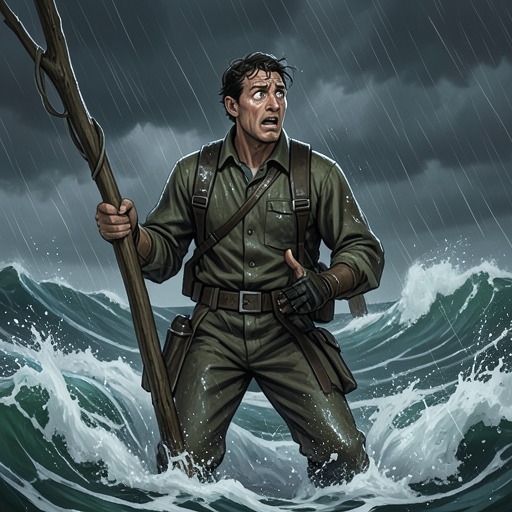
After the ship disappears, Pi imagines that alarms are sounding in distant cities and that people are already organizing a rescue. He expects a ship to appear soon, bringing help for him and the animals aboard the lifeboat. He imagines that his family has survived in another boat and that he will soon climb aboard a rescue vessel to meet them. His plan is correspondingly narrow: he needs only to stay alive for the next few hours. Even his attempt to use the net is made within this temporary outlook, as he rolls it up and places it across the tarpaulin as a small barrier while watching the hyena and the horizon.
At daybreak, this expectation takes on renewed force. The light returns gradually, the horizon becomes clear, and Pi experiences hope as a physical and emotional lift. He believes that surviving the night means the worst is over and anticipates rescue that day. His mind supplies a series of possible reunions: Ravi Patel will greet him with a teasing remark, Pi’s father will appear dishevelled, and Pi’s mother will take him in her arms. The imagined welcome is specific, but it remains an imagined future. While Pi turns his attention outward, the hyena attacks the zebra. His focus on rescue has not made the immediate dangers disappear; it has delayed his attention to them.
The Turn from Expectation to Work
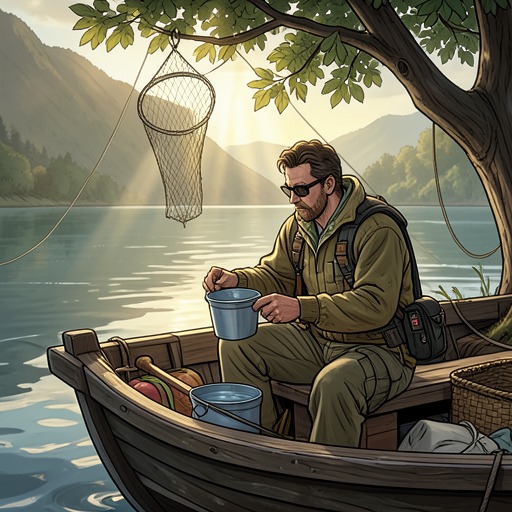
The decisive change comes when Pi recognizes that he has too much to do to rely on outside help. Richard Parker will soon finish the animal carcasses, so Pi must begin fishing. He needs shelter from sun, wind, rain, and sea, and he must improve the raft so that it is not merely seaworthy but habitable. Constant exposure to wetness has left his skin swollen and wrinkled; he also needs a way to keep himself dry and to store supplies on the raft. A second rope is necessary in case the first connection to the lifeboat breaks or comes loose. Each need makes survival concrete: it depends on supplies, shelter, secure attachments, and work performed before those needs become more urgent.
Pi draws a broader lesson from this inventory. In his judgment, a castaway’s gravest mistake is to hope too much and do too little. Looking toward the horizon without acting nearby amounts to letting life pass in expectation. The principle is not that rescue is impossible, but that it cannot serve as the plan on which immediate survival depends. Pi must attend to what is at hand and take responsibility for the next task. That realization does not arrive as a triumphant declaration. Looking out over the water, he recognizes how alone he is and breaks down in tears; his situation still feels hopeless even after he has identified what must be done.
Hope Tested by Repeated Failure
The later attempts to attract passing ships expose the limits of the earlier rescue fantasy. On many nights Pi believes he sees a distant light and fires first rocket flares, then hand flares. Each attempt produces no response. The lights might be ships that fail to see him, stars reflected on the ocean, or waves made deceptive by moonlight and longing; Pi cannot establish which. What he can establish is the repeated result: hope rises, then falls, with no rescue following.
Pi eventually stops counting on a ship. He reasons from his position on the raft: if the horizon is only two and a half miles away when his eyes are five feet above the water, it is closer still when he sits with his eyes less than three feet above it. A vessel crossing the immense Pacific would have to pass through that small visible circle and notice him there. The arithmetic turns an abstract fear into an appraisal of scale and chance. Pi concludes that unreliable human intervention cannot be the basis of his survival. His objective changes from being seen by a ship to reaching firm land.
What Hope Becomes
The failed signals do not leave Pi with nothing. The smell of spent hand-flare shells recalls Pondicherry so powerfully that the town seems to return to him, briefly easing the disappointment of calling for help without being heard. The memory offers relief, but not a rescue plan; Pi understands that the flare has summoned a place in his mind rather than brought anyone to his raft. Even the same signal has different consequences nearby: Richard Parker freezes when a hand flare hisses to life, while Pi has to turn from its brightness and wave it above the water. During one flare, the water around the raft reveals fish. The episode briefly makes the act of signaling coincide with a visible, immediate fact in the surrounding sea, though no ship answers.
The concept’s central distinction is therefore between hope as passive expectation and hope disciplined by action. Early on, Pi treats reunion as the likely outcome of waiting through a few more hours. Later, he gives up the promise of a ship and directs himself toward tasks he can perform and a destination he must reach. His grief and fear remain part of the change, not evidence that it has failed: he can recognize his isolation, mourn it, and still face the work required. Survival begins not when every hope is extinguished, but when an imagined rescue ceases to excuse inaction and attention returns to what can be done.